


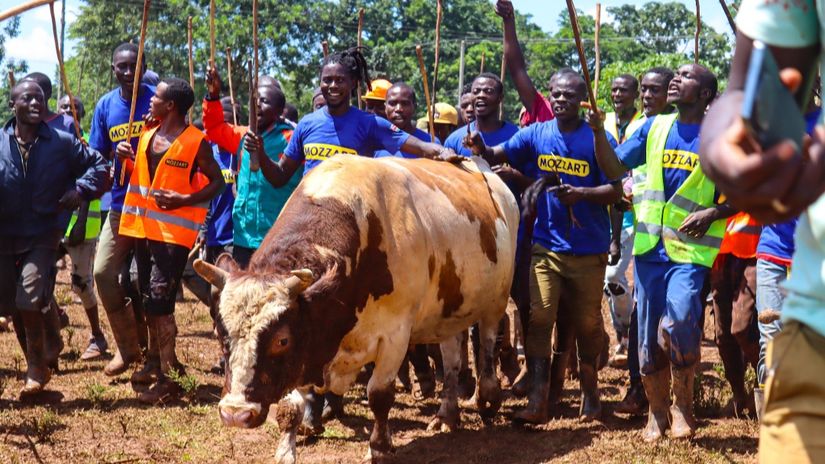
Bullfighting preparations: From men practising celibacy to feeding bulls chapati



.jpg)



Reading Time: 5min | Mon. 02.12.24. | 19:52
The sport is largely practiced by the Isukha and Idakho clans of the Luhya community
Men involved in preparing a bull for a fight are strictly prohibited from engaging in sex on the night preceding the contest.
This is considered one of the crucial customs to be adhered to in the preparation for a fight that entails meticulously planning and executing while observing the established cultural practices.
For starters, a lot happens behind the scenes before a bull is let free from its kraal and led to the ring for a fight, which is always confirmed by both owners beforehand.
Bullfighting is largely practiced by the Isukha and Idakho clans of the Luhya community as a way of celebrating their rich culture.
Why men are prohibited from having sex before a fight
Mozzart Sport sought to understand some of the dos and don'ts observed before a match, how a bull is prepared, the instructions given, and what it means to win or lose a fight.
Timothy Shiveka, a bullfighting enthusiast, who has been actively involved in raring fighter bulls in the last five years, revealed that preparing a bull is an exclusive exercise for men.
Shiveka said men tasked with the responsibility of ensuring the final touches are smooth are not allowed to enjoy conjugal rights as they believe, it comes with bad luck.
"We strictly follow what our forefathers used to do and believed in. Preparing a bull for a fight is done by men only.
Men are not allowed to engage in sex for at least a day to fight as we believe it will bring bad luck to our bull. If this is not observed, your bull can not win," he opened.
How this is enforced?
To ensure that men preparing the bull practice celibacy, they convene at the home of the bull owner for a night virgil.
During the overnight stay, the men are tasked with pysching up the ox and giving it firm instructions.
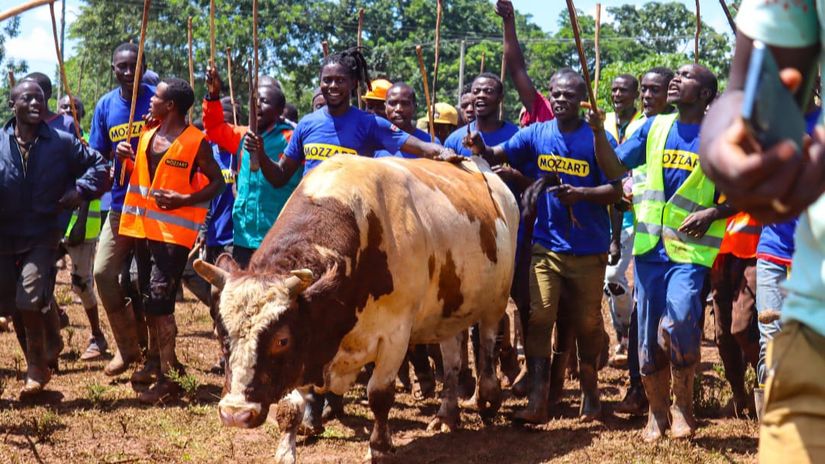
The men light up bonfires and prepare meals with ugali and fish being the preferred dish for the night.
Traditional brews are served in plenty in line with the set customs.
The bull is instructed to preserve the pride of the family and village by giving the best in the ring and avoiding the spilling of human blood.
"We normally gather at the home of the bull owner for our last preparations. We sing, dance, take meals and traditional brews just like our forefathers did.
Bull handlers take turns in warning it against harming anyone as the fight is supposed to be something that brings joy and not pain.
We psych it up and if it responds with heavy moos, we believe it has taken the instructions," said Shiveka.
Are bulls given bhang before a fight?
For a long time, it has been alleged that fighter bulls are given bhang and other stimulants on the eve of a fight.
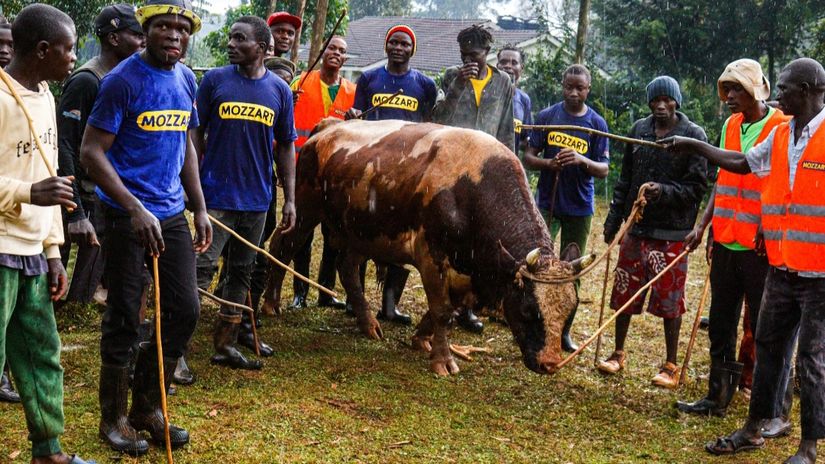
Shiveka, who currently takes care of four bulls, admitted that stimulation is normal before a fight, but he did not clarify whether cannabis sativa is used or not.
Instead, traditional herbs, napier grass, molasses, hay, rice, and animal feeds are used to energize the bull.
Interestingly, in some instances, the bull is given chapati.
Besides the food and stimulant, the bull is taken on rigorous road work days to the contest to be fully fit.
"After giving the bull instructions, we always stimulate it using traditional herbs. We try as much as we can to ensure that the bull is strong enough to give us victory. We also sharpen the horns," opened up Shiveka, while displaying heavy marks inflicted by the sharp horns of the aggressive bulls he has encountered on the ring.
Cost of maintaining and value attached to a bull
Shiveka disclosed that it costs at least Ksh1000 daily to feed, train, and maintain a bull.
Interestingly, the appearance fees that bulls are given for a certain fight are not even commensurate with the maintenance fees thus making no economic value.
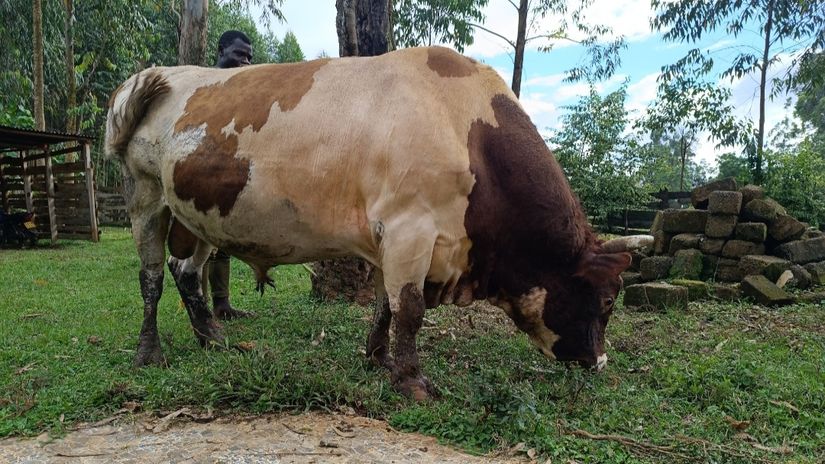
However, Shiveka said the pride of winning a bout comes second to none and the value of a bull shoots up when it consistently wins matches.
"Keeping a bull is very expensive. It consumes a lot of food and water. You also have to pay the person taking care of it. We do not get much from the fights as it is a cultural thing and not commercial.
However, a bull that has won several fights is sold for close to a million shillings. I have seen bulls fetch close to Ksh700,000. Bulls which rarely win fights are sold at a throwaway price," he said.
Levis Manga, a seasoned bullfighter revealed that he had made millions from the sale of his bulls to prominent people including high-ranking government officials.
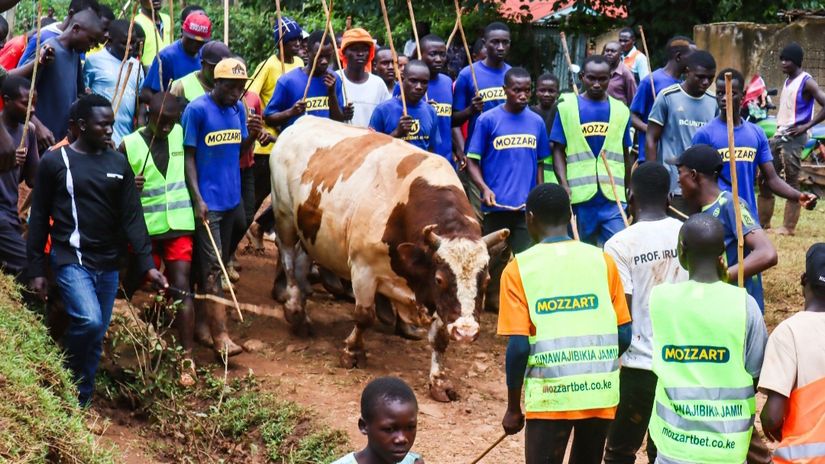
Manga echoed Shiveka's observation that bulls with a decent winning record are a hot cake in the market as opposed to ones that seldom win contests.
"It is very costly to maintain a bull but the rewards are handsome in case you decide to sell it. A bull with a record of winning matches goes for hundreds of thousands making it easy for a farmer to reap the investments made," said Manga.
How bullfighting fixtures are planned
Just like in any other sport, bullfighting has home and away fixtures which are agreed on by both parties in writing.
Shiveka's close friend Raydon Bab G told Mozzart Sport that fights in Kakamega are sanctioned by a man whom he identified as Shipangalia.
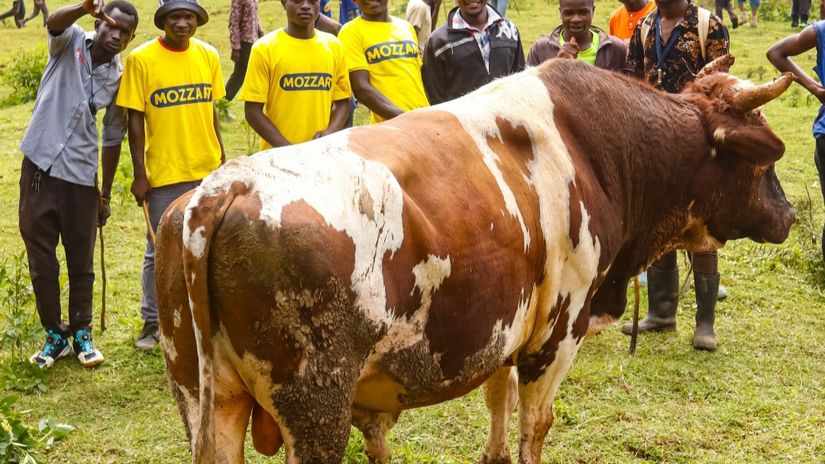
Raydon, who owns the bull christened Professor Irungu, said Shipangalia confirms the fixture and dispatches letters to both bull owners, confirming the time and venue.
If a bull fights in away territory, the owner is obligated to organize a return match, in the interest of fairness.
"We always have home and away matches. Your bull can not be considered champion if it does not win home and away matches. The contests are well-planned and communicated in advance.
The prior communication helps the bull owners to prepare well and pass the message to the fans," said Bab G.